Monday, January 19, 2015

EP6T


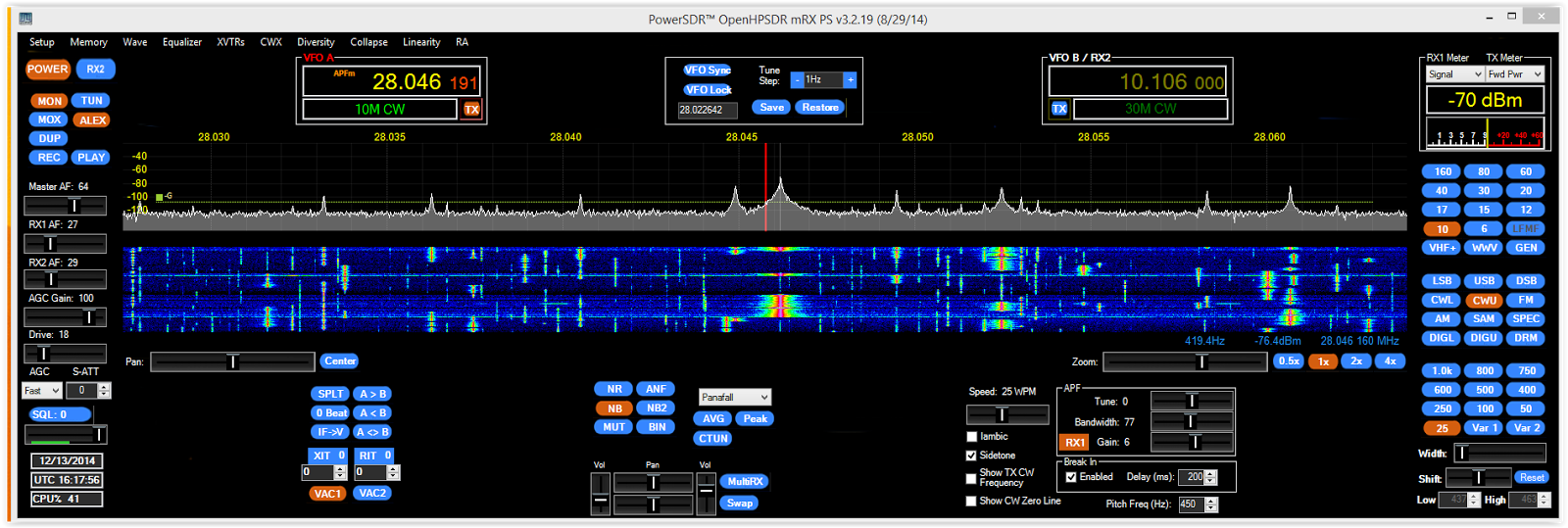
I worked them 10 minutes before sundown local.  (the above was taken about an hour later)  The pileup was amazing


Very very dense RF.  The SDR/CWskimmer combo was invaluable in analyzing the pileup.  eventually he moved down the pileup to about 1.5 khz above his transmit freq where the signals were sparse and that is where I worked him.  All those guys who were 8 khz up the band were never in the running.  The opposite happened to me last night.  I spent 3 hours trying to work him on 30M but I didn't have any propagation to EU or AS and last night I was transmitting up 2-3 and he was listening up 7, so no way last night.  the panfall and skimmerfall did not help at all.  When I realized he was up 7, the terminator had overflown his head and he soon faded into the noise of day light.

If you look closely at the way I have the radio set up I am listening to EP6T on the B vfo and transmitting on the A vfo.  I do this because click tuning on skimmer causes VFO A to change, so it makes skipping around the pileup much more ergonomic.  Once I get the DX tuned in perfectly I set the lock on vfo B so I don't click myself off freq at the wrong time. and set the TX to VFO A.  With the Flex 6300 all of the controls related to each "slice" such as DSP, AGC-T volume AGC RIT etc are available on both vfo flags so it's super easy to fine tune either vfo's properties.  I also run my FlexControl tuning through DDUTIL v3.0 because its very easy to switch between VFO A and VFO B


simply by pressing the knob.  Another advantage of this single-panadapter-2-VFO implementation is it's quick to deploy.  The disadvantage is the decoder aspect of Skimmer is lost since the decoder goes with VFO A and the DX station is on VFO B.  Not a big loss since I copy in my head anyway.   

There is another way to deploy SSDR for split DX ops and that is to use slices!


As you can see now panadapters are independent and there are 2 skimmers.  With 2 skimmers the decode function of skimmer works in each skimmerfall so that aspect is preserved.  In addition each skimmer decodes independently so the information in each skimmer is not a mirror of the other.  This means if the DX is sending a callsign and I want to tail end I have a greater opportunity to discover where that station is in the pileup and click tune to that freq.  I always set up the skimmer streams to match horizontally.  My transmitter slice is always B so even if see the call in slice A it's heartbeat quick to slip the mouse over to slice B and click to tail end a given station.  Skimmer does one more thing it repoerts out a decoded 599 as a red flag
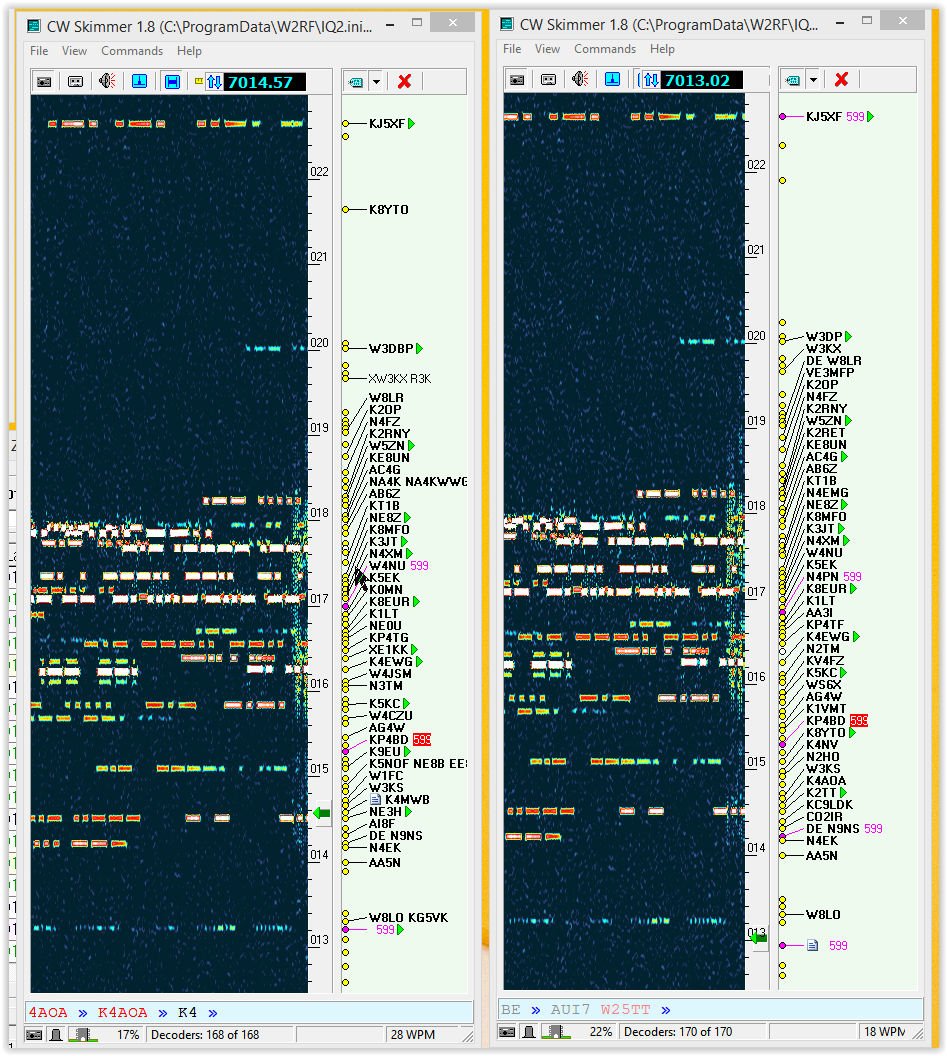

with the most recent 599 as bold and bright red.  This is a big clue of where to tail end but not infallible.  There are a LOT of stations who think they are working the DX and sending 599 when they are not even in the ballpark.  Tracking 599's is a good way to discern where the DX is moving in the pileup.  Like bread crumbs you can pick out if he is moving up or down and try to insert yourself into where he is going to be listening next.  This is the technique I used tonight I saw him moving down and placed my transmitter at the next clear spot on the panadapter and 10 minutes to sundown he was in the log.  

Over the years it interesting to see how skimmer has changed working pileups.  The RF in the panfall and skimmerfall ball becomes much more dense as 599's are handed out.  So once again even skimmer use requires strategy.  On to 30M and 80M!!

73  W9OY

Got them on 30M at their sunrise!!  The panfall and skimmerfall did help but in a unique way.  Once again I had no propagation stateside.and EP6T was working NA.  He was had a nice signal and the band was really quiet.  Occasionally skimmer would decode a lone stateside callsign so there was some kind of backscatter poking a bit of stateside coherence through the noise.  This mode of propagation turned out to be quite useful.  I was relying on cluster spots to steer my transmit freq but these were inconsistent , up 2.7, up 3.8, who knows where he was listening.  The previous night while listening on 30M I noticed there were a trail of white spots on the pan up 7-10 khz, but I thought they were too far away to be in the pileup and I didn't want to QRM some joker calling CQ.  It turned out this was precisely where the DX was listening and the falling dots in the waterfall, were actually the pileup.   

Not to be fooled twice, watching the panfall I noticed occasional streams of white dots on 10.125 falling down the waterfall, streams that were maybe 50hz apart, consistent with a couple stations breaking the propagation induced radio silence.  The DX was on 10.123 (actually 10.122847, the Flex's filters are tight enough that if I tuned to 10.123000 I could not hear the DX).  It was clear from the way he was working stations he was pretty much hugging one freq on RX and up 2 seemed a logical choice so I started calling there and pretty soon he was in the log.  Once again SDR allowed me to peer into radio darkness and pull out a plumb.  

I have 2 SDR radios, a Anan100D and the Flex 6300.  Each has it's advantages.  When it comes to gleaning information from the panadapter the Flex wins hands down.  I swear it can hear under the noise.  Unfortunately I didn't think to take a pic.

73


Saturday, January 3, 2015

W5GI Mystery Ant


John BasilottoW5GI was a friend of mine.  He was very involved with Flex from it's creation.  He published an antenna idea he created in CQ July 2003.  He claimed it was an antenna that defied explaination.  Here is a pretty good explanation.

I had a 137 ft dipole fed with open wire in the trees but it was struck by lightning and I've been debating whether to put something dipole like ever since.  My open wire tuner is the venerable KW matchbox, but I'm hooked on my MFJ-998 auto tuner for ease of band change.  I decided to give John's antenna a whirl since it's touted to be easy to tune and a pretty good match 80, 40, 30, 20, 17, 15, 12, 10. and 6.  A tall order for sure!  I recently put up a vertical dipole for the 10 meter test which gave me a ready skyhook to pull up the W5GI.

Last summer I purchased a W5GI from Joe K4TR over in Brooksville, FL across the state from me.  It's been sitting in the box ever since.  This antenna is very well built, and while I had enough stuff around to home brew it I didn't want to fool with tuning and primping to a fare the well, which is my general nature when it comes to ham radio.  I pulled down the 10M vertical dipole and hoisted the W5GI aloft.  It's up about 55ft and I shot some rope into 2 other trees so the ends are up about 25-30 ft.  High enough to keep away from ground effects but low enough to not get tangled in the lowest branches of the trees.  I coiled up the excess coax into an ugly balun about 10" in diameter and set about to test out my mystery antenna.

I ran some SWR data 80-6 with no tuner to get a general idea of what I was going to be up against.  Here is the result.


Pretty damn good!!   I am able to tune to low SWR on every spot on every band and then run a KW once tuned.  I don't perceive any RF ingress into the shack.  My radios and amp (ALS-1300) are smooth as butter.  It's basically a 102 ft dipole broadside into north Africa.  I was tuning around this evening around 2300 Z about sundown on 80 and heard several EU and worked a couple and then a couple in Africa running a KW on CW.  The antenna is a little bit quieter than my full size 80M vertical with a bazillion radials.  The verticals take the cake on 80 and 40 but they are very close to the W5GI and I can foresee there will be conditions where the W5GI will win.  I have the Verticals on port 1 of the tuner and the W5GI on port 2 so it's dead easy to compare.  

Overall I'm very pleased!  It's very stealthy in the trees, it covers everywhere from 80 to 6 and handles a KW without batting an eye and gives me one button rapid tuning so I don't have to screw around with the dip da dip da dip di dip and It took less than an hour to get it into the sky.

73  W9OY

Sunday, December 14, 2014

ARRL 10M

I REALLY wanted to get my 10M DXCC totals up before the sunspots go kaput.  My 10M antennas are horrible.  I generally load up a 80M vertical and it either works or it doesn't.


Here is a shot of the 10M pattern of my 80M vertical.  There is low medium and high angle radiation.  I decided to try a vertical dipole cut for 10M which looks like this


Imagine the dotted vertical line is a tree and the dotted horizontal is a branch.  Wire 3 angles back toward the tree and feed line 4 angles over to another tree to try and get as much seperation between the two as possible.  I was able to get the dipole up to about 50ft in the tree using my lead sinker pneumatic canon.  One shot was all it took.  I love this thing for hanging antennas.

The pattern for the dipole is like this


It still has some low medium and high radiation but the reduction in gain is reversed so the max is a low angle takeoff.  The 3D pattern looks like this


I did the analysis with and without the bent leg and feedline in the picture and the pattern skewing was minimal.  It was dark by the time I had things hooked up and the temp had dropped to the 40's and I was using a flashlight to see what I was doing... aka perfect antenna hanging weather.


I fired up the rig and the band was of course dead but I did manage to work FY5KE in French Guiana with a big signal the night before the contest 


I started working stations Sat and the band was pretty good but not outstanding.  A was 21 and K was 3, SFI around 150 


The station I'm listening to is Fred NP2X in the US VI.  The guy has a monster signal and is a monster of a contest operator.  I've known him since our college days at Univ of Ill.  

The band noise was quiet about -137 dBm.  I also set things up so I could A/B my 80M vert vs the 10M vert dipole at a button press.  What I found was pretty much what the patterns predicted.  On US stations the 80M antenna was a little louder.  On medium hall into EU or to KH6 the antennas were pretty much equal and on long haul deep into Asiatic Russia the dipole was a little better.

I could only operate a few of the best contest hours but managed to work 44 new 10 M countries all over the world.  I used every method I could think of to route out stations, spot collector which I set to spot only 10M spots


I used CW skimmer to skim sections of the band for new ones, and I also used the old tried and true method of starting at the bottom of the band and working to the top identifying every little blip on the panfall.  I used write log to do the dupe-ing


I did not setup the writelog band scope.  

As soon as the contest was over, I turned on all the bands in Spot Collector and saw S01WS in Western Sahara on 80M so I switched down there and worked him on the third call


To tell the truth I feel MUCH more at home digging the weak ones out of 80M static than up in nose bleed territory on 10M   Good times!

73  W9OY


Friday, December 5, 2014

So I'm driving to work this morning and glance off to my right and this is what I see:


This thing is a monster!  (I know there is a SDR in there somewhere so it counts :) )

73  W9OY

Saturday, November 29, 2014

6300's turn

Last night I ran my Anan 100D in the contest and had a ball.  I was working only band fills and new ones so I spent my time listening.

Tonight I fired up the Flex 6300.


40M


80M

Using the same antennas as last night.  My radios are set up such that I can pull 2 plugs in the patch panel and switch rigs.  Everything else remains the same including software keyer computer etc.  The bands are about the same as last night.  I ran some test on band noise and the noise is virtually identical


below the band my radio is seeing 104 dBm


This is about 8 khz into the band 


And this one is mid band.  You can see from the wideband shot above there is considerable RF above and below.

My impression is the Flex is a cleaner radio in its operation.  The CW is better and the radio is quieter compared to the Anan and I think the filters are better even though the Anan has more taps.  One thing I miss on the 6300 however is diversity.  I would have to advance all the way to a 6700 to acquire that feature.  The Flex also connects to most of my software via the API as opposed to CAT and this is considerably faster and smoother in operation.  I enjoy either rig, and find them booth superior to my old knob radios like the FT-1000D and the Orion


Here is an example of SDR in action.  The yellow cursor is on V26K who is 3-5 dBm out of the noise.  On either side are stations considerably stronger about 100hz off freq.  V26K is single signal with no QRM QRN or AGC pumping from the other close by stations.  I worked him in a single call.

73  W9OY

Friday, November 28, 2014

6 Centuries and a most wonderful time of the year

I'm sitting here picking off band slots on 80 and 40 in CQWW CW test.  The A is 5 and the K is 1 and SFI is 181.  To say the least things are jumping


For me this is a most wonderful time of the year.  Turkey sandwiches family cheer and DX out the wazoo!!  I looks like it's snowing RF!!


I decided to pull a couple of screen shots which show the S meter reading below the 40 M band 


a few khz into the band 


and in the middle of the CW band


All S meter readings are virtually identical so I guess the RF storm doesn't have much effect on the front end.  These were taken with the front end filters turned off.

I finished off 6 centuries a few days ago.


The saga began when I decided a new direct conversion SDR deserved to see how much could be accomplished regarding DX.  I started on June 6th in the middle of the summer and by Oct 4th had 5BDXCC worked (4 months).  I decided to apply to LOTW and see what had been confirmed in mid November and had confirmed DXCC on LOTW.  I kept whacking at 80M as I had 55 more to go to finish that band.  I completed 6BDXCC a week ago a couple weeks shy of 6 months.  

The Flex 6300 and the Anan 100D both worked beautifully in completion of this task.  About half of of the total QSO's (around 700) was completed with each radio giving me a very good comparison between the two radios.  I pretty much just worked new band slots and spent the rest of the time listening which is my preference.  With the Flex 5000 I had run up my DXCC total to around 287 in 3 years.  With that radio I was pretty much exclusively 160 80 and 40 but it does give a relative idea how well the new radios compare to the older technology.  My antennas are simple verticals but only optimized on 80 40 30 and 20.  17 15 12 10 and 6 were based on tuning the 80M vertical.  I think if I had some kind of beam 9BDXCC would have been easily obtained.

Overall it's been a gas.  Unless I put up some new antennas this is about as far as I'm going to push this project.  I've never been one to chase the paper.  Both radios made making the QSO's like shooting fish in a barrel.  Many contacts even in the big pileups like the FT4TA DXpedition were made in less than 10 calls.  between DXLab suites Spot collector, DXkeeper and DXview, the DDUTIL software, CW skimmer and SDR bridge the whole rigmarole was incredibly efficient.  If you want to change your ham radio life get a SDR!

Hope one and all had a Happy Thanksgiving

73  W9OY  

Monday, November 10, 2014

FT4TA

Tromelin

Off the east coast of Africa next to Madagascar lays a 1 km square island called Tromelin


The entity became active as FT4TA on Oct 30 


The pileups were massive


On 30M which is 50 khz wide the pileup extended a full 20 khz or 60% of the band.  Amazing!  In fact the pileup was so wide it was out of range to be able to click tune the transmit VFO I usually use (VFO B) on skimmer.  To combat the problem I used a different strategy


I switched VFO A and  B sing the A<>B control and chose VFO A as the transmit VFO


I then turned off the audio from VFO A and switched on MultiRX and turned up the audio on VFO B


This put the DX on VFO B and allowed me to click tune on skimmer anywhere on the band tramsmitting on VFO A


This was absolutely invaluable.  Skimmer only allows about 11 khz of the band to be displayed but with this configuration I could place that 11 khz window anywhere.  Using this method and by studying the operators preference I was able to place signal into his receiver passband and my callsign into his conscientiousness in only 1 call.  I couldn't believe how effective this technique was.  I worked him on 30M about 30 min before his sunrise and then saw he was also on 80M.  I switched to 80 and turned on the amp.  He had a good signal and I figured out his pattern and in 15 minutes I had 80M and 30M in the log


I was hoping for a 40M contact but decided I would likely have to be satisfied with 80 and 30.  I listened to him work the pileup for a considerable time while doing other things and soon enough he was spotted on 40M but by now it was deep into his sunrise.  I flipped on 40M and sure enough I could just copy him so I fired things up and in a few minutes I had him on 40 also.


Amazing!  My 30M call was at 1:42 and by 2:53 I had him on 3 bands.  The total number of calls for all three contacts was probably a dozen with careful use of the panadapter, skimmer, and SpotCollector.  This radio rocks!  Today the DXpedition posted their log


I'm not sure how one could accomplish navigating a 20khz wide pileup without the advantage of SDR and skimmer and SpotCollector   None of those are fool proof but each gives a small piece of information allowing one to predict with fairly good accuracy where and when the DX will be listening.  

I also worked him on 80M using my Flex 6300 radio and signal strength and readability were comparable using the same antennas.  The 6300 with 2 panadapters active and 2 skimmers active is a much more efficient setup for this kind of huge pileup but both radios performed FB

73  W9OY