Sunday, February 1, 2015

Navassa is on the air!!!


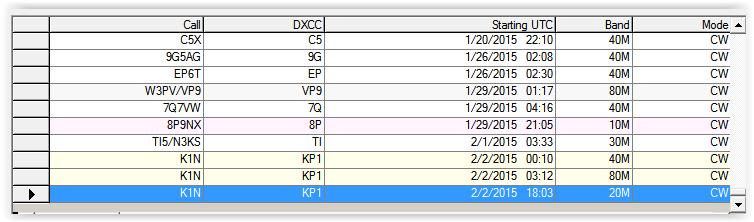
Stopped in the shack to see what was going on around 00:00Z and K1N was banging away on 40M.  The first call was reported at 18:52 and by the time I got there at 00:00 things were bedlam in the pileup


They were strong Peaking over S9 


By 00:10 they were in the log!  


The op W2GD was smooth as butter flying up and down the pileup knocking them off right and left.  I was able to discern a ascent as he climbed the freq ladder with his receiver and placed myself directly on a collision course so my signal would hit his ears.  Took not more than 10 calls.  I worked him on my dipole with about 1200W.  

I had to run to the drug store and the bank and when I returned 80M had exploded.  They promised to try and get two or three rigs running tonight and they kept their promise.  It took me a little longer to sort out this pileup


But in about 4 calls they were in the log


Also a very good S9+ signal on 80M


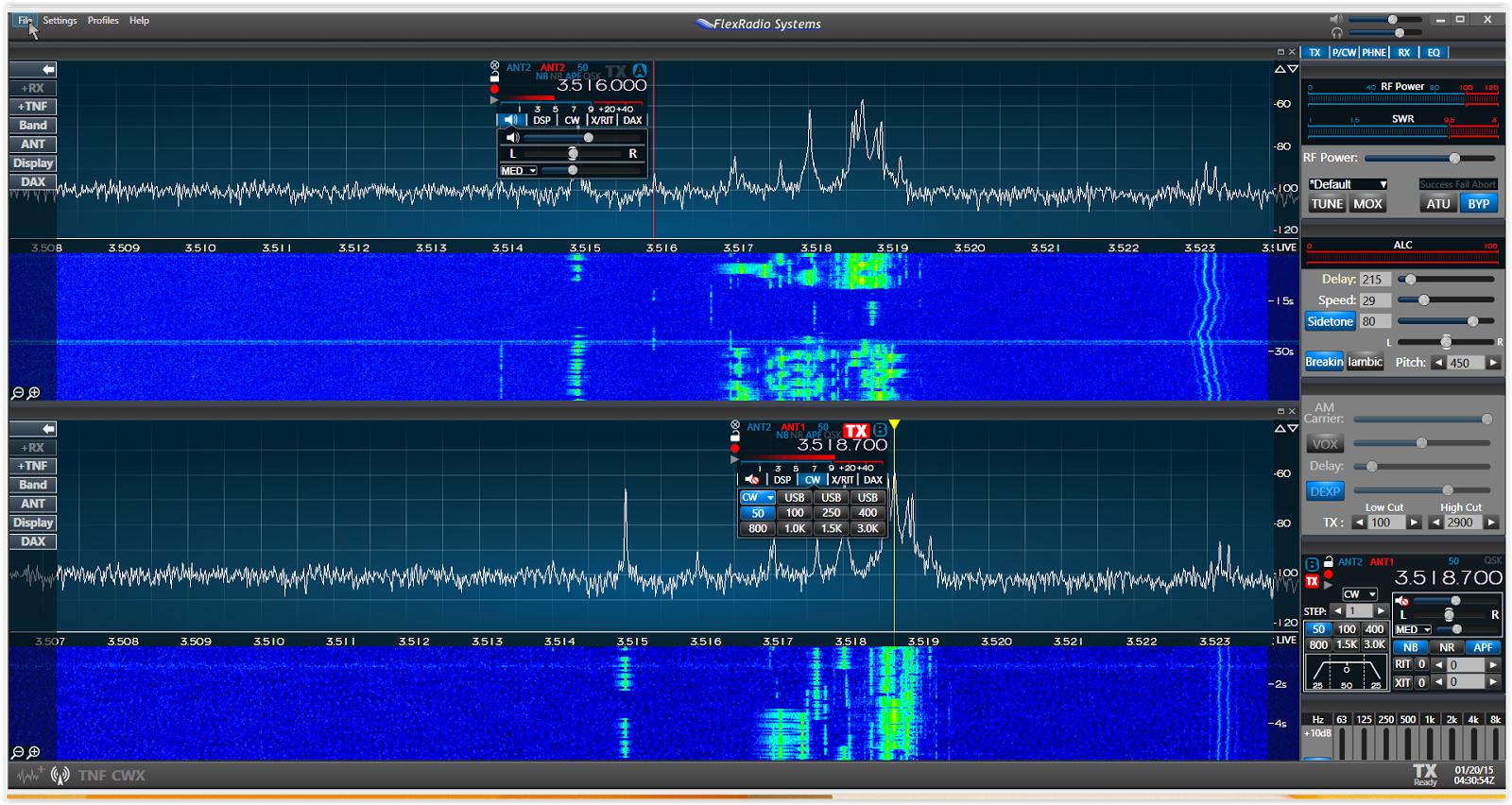
The op on 80 was as butter smooth as the op on 40 had been.  When the QRM-ing got bad he shut down for 5 minutes and the pileup dissipated.  He was working high up in the pile maybe 3537 when he stopped and came back to 3525 when he returned.  When he got back he was calling EU and he worked some EU.  Amazingly NA stood by while he worked what EU he could hear.  Eventually he ran out of EU takers and reverted to all comers.  It was then I got him in the log.  There were tuner uppers all over the place but the Flex has a secret weapon for tuner uppers.  It's called TNF or tracking notch filter.  I tuned on this missal and zap the bastards like zapping a but.  K1N was perfectly Q5 but the QRM was virtually gone, even though the QRM was 10dB stronger than the DX.  The filter acts like a tune-able notch.  Stop bandwidth and freq are tune-able and you just zero such that the DX can be heard and the QRM can't


This radio never fails to impress!  I'm already a happy camper.  I hope to pick them up on 30M and then I'll be satisfied and give someone else a shot.  I'm pretty sure I could fill all band slots.  They are only 800 miles from my doorstep.  I may also try 160 but my antennas suck there so I don't hold out much hope for that band.  Give Navassa a whirl.  The last DXpedition there was 22 years and it will be a minimum of 10 years till the next window opens.  I think panning for this trip started in 1999.  Do not miss!!

73  W9OY

2/2/2015

Got them on 20!   Never expected to do that since I'm only running a dipole.  Another great OP with a rate around 100/hr   

I used the radio set up slightly differently 


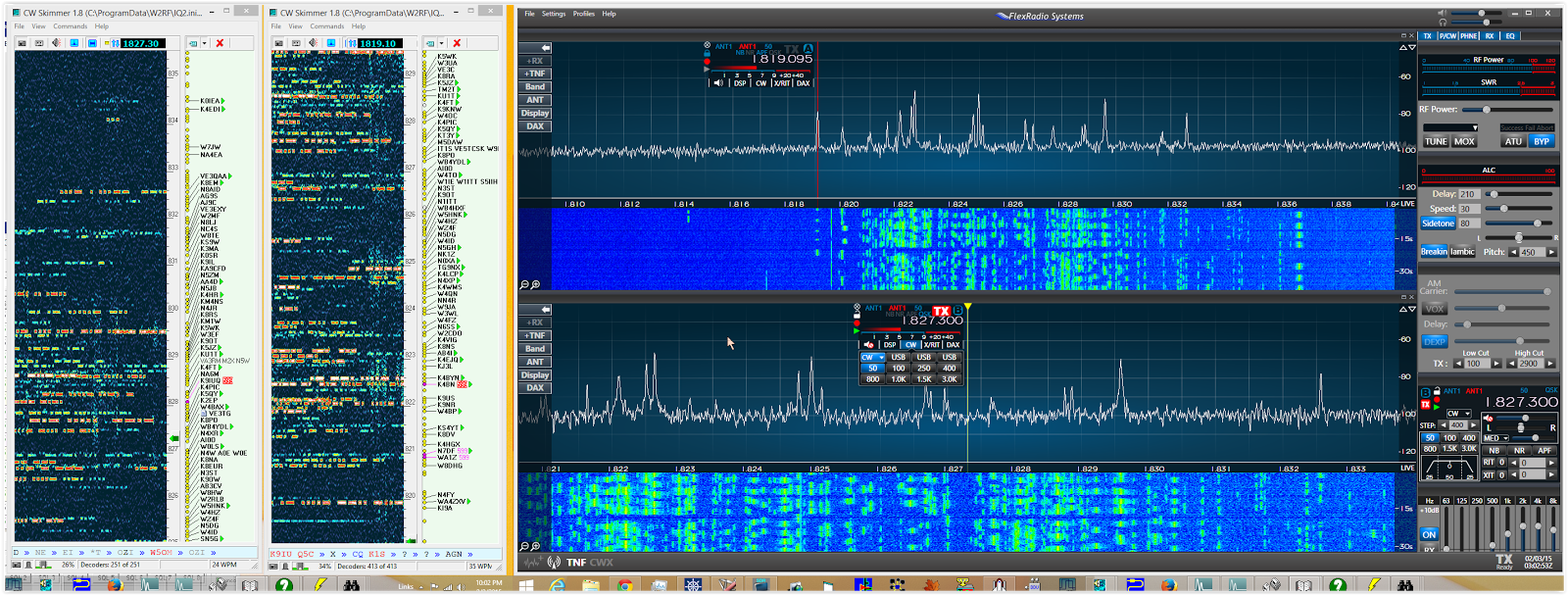
I had only one panadapter and one skimmer fired up.  I can still click around the pileup for tail ending but that wasn't how this OP was working the pile.  He was rapidly ascending and descending in the pileup and the only way I got him given all the strong 20M signals was to run ahead of his ascent or descent and try to have him pick me off as he passed by.  Very dynamic action and took maybe 25 minutes to work him even with my puny 20M sig.  You could tell where he was by the series of bold red 599's he left in his wake as well as looking for the call signs on the skimmer fall as he worked them.   Still hope to catch them on 30M

73 W9OY

2/2/2015 

30M is in the log  


This was the hardest yet.  They were louder on the vertical compared to the dipole.  The OP was working S&P contest style often making 2-3 khz jumps as he zipped up and down the pileup but sometimes just a few hz so you couldn't tell exactly how to position yourself.  Also he was basically working contest style as far as calls go.  It was bang bang and if you tried to call more than once he was long gone by the time you started to listen.  His technique maintained a high rate of contacts.  He was also quite well known by the pileup stopping to say HI to stations as he made the QSO with them  Makes for a very friendly sounding pileup.  He was using a move up the band technique.  When deliberate QRM started he would nudge himself up the band a dab and continue working the pileup while the QRMers were left looking like the dumb asses they are.  I'm very much enjoying this DXpedition.  I may give 160 a whirl.

73  W9OY

2/2/2015

I can not freakin believe it, 160 is in the log!!  He was about S8 here, excellent signal.

I worked him on my 101 foot long W5GI mystery antenna tuned up on 160 and running 500W.   I worked him in 5 calls unbelievable.


73  W9OY


Monday, January 26, 2015

EP6T redux

I managed 3 QSO's with EP6T, one on 30M and the other 2 on 40M.  The first 40M contact was busted.  They had an odd operating style that screwed up the normal rhythm of a DX contact.  If they got a partial like W9O they would send something like W9O? 599 and you would reply but you were never quite sure they got your callsign.  It would also breakup the normal bang-bang rhythm.  I think if they would have changed one thing it would be to go back to bang bang with each station until the qso was confirmed.  I could NOT have made any contacts with them without the Flex 6300.  I have 2 SDR radios that I use extensively, the Flex and a Anan 100D.  I like the Anan for it's diversity reception and the ability to steer the received signal.  It would take upgrading to the 6700 to realize this in the Flex line.  But the panadapter and waterfall in the Flex is superior by orders of magnitude.  The Flex 6300's panadapter can peer -19 dBm into the noise floor.  The Flex 6700 can peer -25 dBm into the noise (500hz filter).  This gives the Flex a tremendous advantage in allowing one to analyze what signals are trying to beak through the noise.  All signals are present all the time if only you had the ability to perceive them.  Once you understand there is coherence present you can use that to your advantage.


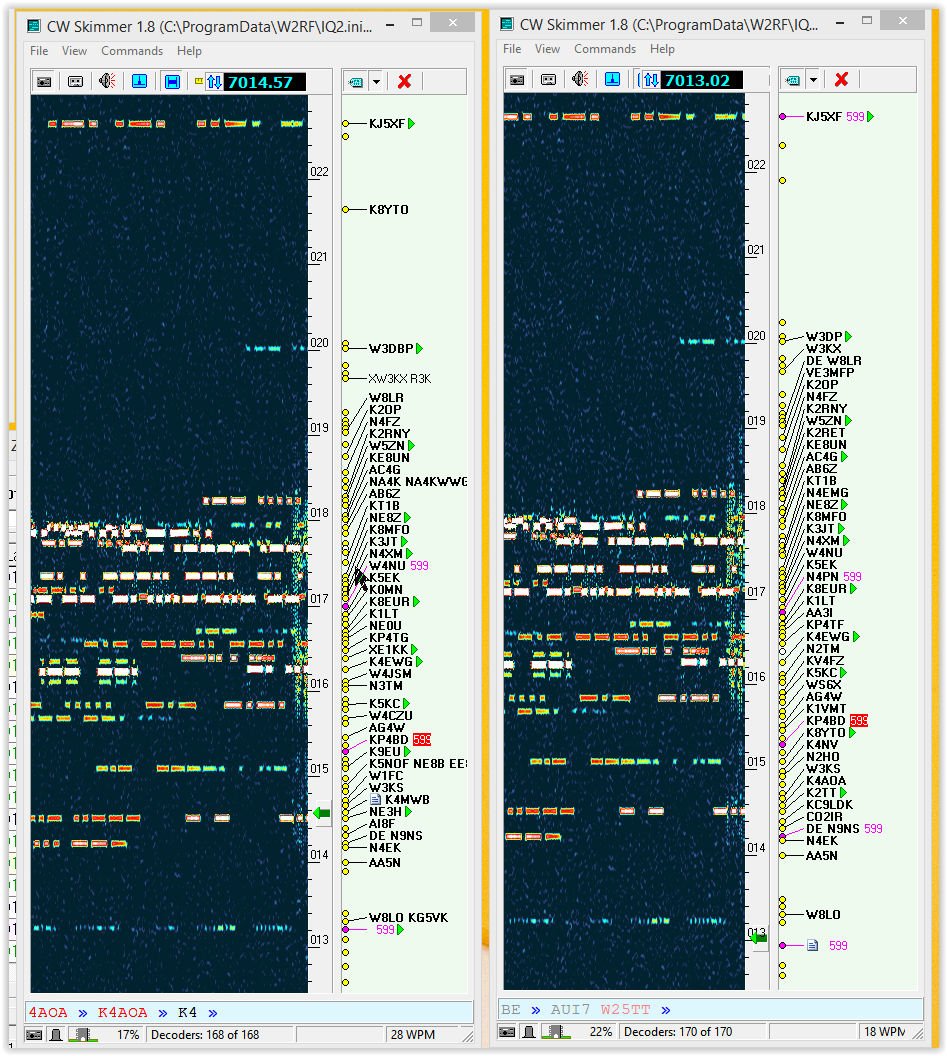
This was the typical pileup on 40M, a barrage of RF!  Notice the pileup is about 10 khz wide.  The dilemma is where to place your transmitter in that mess so the DX will be able to discern your signal over his QRN and QRM.

On 30M this is typical of what I was seeing on the night I made contact


Notice the little trail of dots next to the cursor.  I'm quite sure on his end the pileup was not all that different than the above 40M pileup.  I tried to work them the night before on 30M and I saw the same dot trail about 7-10 khz up the band.  This "10 up" was where the DX was working stations the night before, as reported by the Cluster spots.  Propagation was such that this dot trail is all you could see of the stations calling the DX.  In other words without this little crumb trail of callers you would have no idea where to place your transmitter.  On the Anan this crumb trail was not visible because you can not see as far into the noise with that radio's panfall.  I fired up "up 2" right in the center of the dot trail, and he was in the log in 3 calls.  I never realized the advantage the Flex panfall provides prior to this contact.

My last contact on 40 was made in 2 calls.  I simply watched the DX's pattern on Skimmer (as above) and noticed he was moving down the pileup.  When he got to the bottom where interference was least I heard him work a W4 and saw the red 599 pop up on skimmer.  I immediately clicked that freq and fired off a couple "W9OY's".  He came right back and once again I was in the log  


The op for both contacts was the excellent  Kostas  SV1DPI.  

I understand the EP6T team had big QRN problems.  Apparently they were set up next to a scooter rental store with many battery chargers a.k.a death to a DXpedition.  They were licensed for a specific location so they could not move the station away from the noise.  I can't imagine the frustration to try and hear weak callers through what was reported to be a S9 buzz saw.  Fortunately I was able to crack the puzzle of where to transmit twice for confirmed contacts.  Color me happy.  

Propagation at my QTH started the week good but deteriorated over the next several days only to come back nicely yesterday which is when I made the 40M contact.  I tried and tried on 80M but he was not hearing me on that band.  I did hear them once on 20M but they were absent to me on every other band.  

There is much kvetching on the DX boards about what a lousy operation this was but I didn't find it to be the case at all.  It was merely a challenge.  There have been many DXpeditions I have failed to contact and many I've had success contacting, it's just the nature of the business, and it's what makes DXing fun.  I'm very pleased and grateful for the opportunity.  Clearly making contact with EP6T was a challenge for NA hams.  


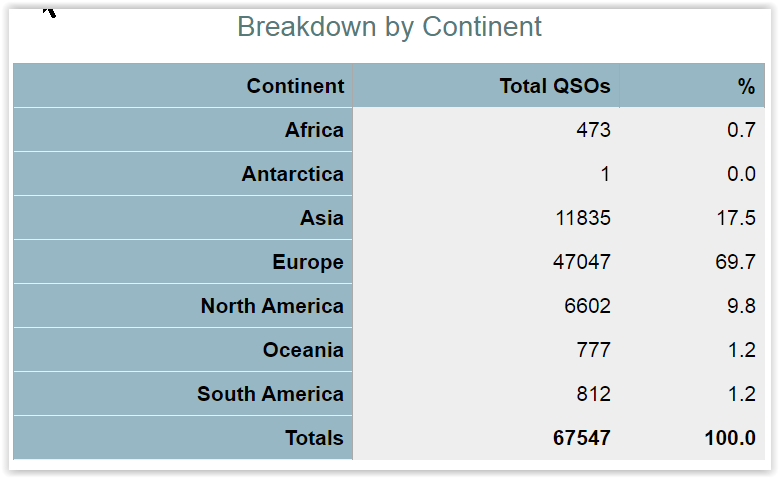
For 67547 QSO's only 6602 were from NA on all bands.  Given the nature of the huge pileups this would indicate very poor conditions (including their local QRN) most of the time between NA.  The days I worked them I consistently heard them trying to control the pileup in favor of NA but the propagation wasn't cooperating compared to EU and neither was the behavior of the EU operators, but thems is the cards that was dealt.  It's interesting to see nearly 5000 QSO's on 10M CW, and 10M overall competing strongly with 20M.  


By Continent it also shows the difficulty of the NA path.  I wish they had paid a little more attention to sunup and sundown propagation.  Many of my local sundowns I could hear them peak on 80M but they were always running JA's at my local sundown which was the JA local sunup.  When the JA's finally passed into daylight it was too late for me since EP6T had started to fade he was still copy-able but no longer enhanced.   


I'm a CW only op so it's interesting for me to look at the broken out CW stats.  For NA a little less than half were CW but very nearly half (including RTTY into the calc).  According to the above it breaks out once you subtract out a RTTY percentage of 34% about 282 30M CW contacts were made with EP6T in NA.  Except for the Flex 6300 I would not have been one of them.   

73  W9OY


Monday, January 19, 2015

C5X


The Gambia on 80M.  I've worked them on several bands... excellent op.  I got them using the W5GI mystery antenna which was about 2 S units quieter than the vertical.  I tried calling with the vertical and listening on the W5GI as the 6300 allows for several antenna combinations, but finally got them with the W5GI.  I was surprised as the W5GI at 55ft has a pretty NVIS pattern on 80M.  I'm sure my proximity to the Atlantic helps.


Once again the split dual slice setup on the 6300 did the trick.  It was a moderate pileup. 


It pays to have more than one antenna

73  W9OY

Just sat down at the rig and they were on 40M.  Got them first call in broad daylight on the half wave end fed vertical!  The bands are good


EP6T


I worked them 10 minutes before sundown local.  (the above was taken about an hour later)  The pileup was amazing


Very very dense RF.  The SDR/CWskimmer combo was invaluable in analyzing the pileup.  eventually he moved down the pileup to about 1.5 khz above his transmit freq where the signals were sparse and that is where I worked him.  All those guys who were 8 khz up the band were never in the running.  The opposite happened to me last night.  I spent 3 hours trying to work him on 30M but I didn't have any propagation to EU or AS and last night I was transmitting up 2-3 and he was listening up 7, so no way last night.  the panfall and skimmerfall did not help at all.  When I realized he was up 7, the terminator had overflown his head and he soon faded into the noise of day light.

If you look closely at the way I have the radio set up I am listening to EP6T on the B vfo and transmitting on the A vfo.  I do this because click tuning on skimmer causes VFO A to change, so it makes skipping around the pileup much more ergonomic.  Once I get the DX tuned in perfectly I set the lock on vfo B so I don't click myself off freq at the wrong time. and set the TX to VFO A.  With the Flex 6300 all of the controls related to each "slice" such as DSP, AGC-T volume AGC RIT etc are available on both vfo flags so it's super easy to fine tune either vfo's properties.  I also run my FlexControl tuning through DDUTIL v3.0 because its very easy to switch between VFO A and VFO B


simply by pressing the knob.  Another advantage of this single-panadapter-2-VFO implementation is it's quick to deploy.  The disadvantage is the decoder aspect of Skimmer is lost since the decoder goes with VFO A and the DX station is on VFO B.  Not a big loss since I copy in my head anyway.   

There is another way to deploy SSDR for split DX ops and that is to use slices!


As you can see now panadapters are independent and there are 2 skimmers.  With 2 skimmers the decode function of skimmer works in each skimmerfall so that aspect is preserved.  In addition each skimmer decodes independently so the information in each skimmer is not a mirror of the other.  This means if the DX is sending a callsign and I want to tail end I have a greater opportunity to discover where that station is in the pileup and click tune to that freq.  I always set up the skimmer streams to match horizontally.  My transmitter slice is always B so even if see the call in slice A it's heartbeat quick to slip the mouse over to slice B and click to tail end a given station.  Skimmer does one more thing it repoerts out a decoded 599 as a red flag


with the most recent 599 as bold and bright red.  This is a big clue of where to tail end but not infallible.  There are a LOT of stations who think they are working the DX and sending 599 when they are not even in the ballpark.  Tracking 599's is a good way to discern where the DX is moving in the pileup.  Like bread crumbs you can pick out if he is moving up or down and try to insert yourself into where he is going to be listening next.  This is the technique I used tonight I saw him moving down and placed my transmitter at the next clear spot on the panadapter and 10 minutes to sundown he was in the log.  

Over the years it interesting to see how skimmer has changed working pileups.  The RF in the panfall and skimmerfall ball becomes much more dense as 599's are handed out.  So once again even skimmer use requires strategy.  On to 30M and 80M!!

73  W9OY

Got them on 30M at their sunrise!!  The panfall and skimmerfall did help but in a unique way.  Once again I had no propagation stateside.and EP6T was working NA.  He was had a nice signal and the band was really quiet.  Occasionally skimmer would decode a lone stateside callsign so there was some kind of backscatter poking a bit of stateside coherence through the noise.  This mode of propagation turned out to be quite useful.  I was relying on cluster spots to steer my transmit freq but these were inconsistent , up 2.7, up 3.8, who knows where he was listening.  The previous night while listening on 30M I noticed there were a trail of white spots on the pan up 7-10 khz, but I thought they were too far away to be in the pileup and I didn't want to QRM some joker calling CQ.  It turned out this was precisely where the DX was listening and the falling dots in the waterfall, were actually the pileup.   

Not to be fooled twice, watching the panfall I noticed occasional streams of white dots on 10.125 falling down the waterfall, streams that were maybe 50hz apart, consistent with a couple stations breaking the propagation induced radio silence.  The DX was on 10.123 (actually 10.122847, the Flex's filters are tight enough that if I tuned to 10.123000 I could not hear the DX).  It was clear from the way he was working stations he was pretty much hugging one freq on RX and up 2 seemed a logical choice so I started calling there and pretty soon he was in the log.  Once again SDR allowed me to peer into radio darkness and pull out a plumb.  

I have 2 SDR radios, a Anan100D and the Flex 6300.  Each has it's advantages.  When it comes to gleaning information from the panadapter the Flex wins hands down.  I swear it can hear under the noise.  Unfortunately I didn't think to take a pic.

73


Saturday, January 3, 2015

W5GI Mystery Ant


John BasilottoW5GI was a friend of mine.  He was very involved with Flex from it's creation.  He published an antenna idea he created in CQ July 2003.  He claimed it was an antenna that defied explaination.  Here is a pretty good explanation.

I had a 137 ft dipole fed with open wire in the trees but it was struck by lightning and I've been debating whether to put something dipole like ever since.  My open wire tuner is the venerable KW matchbox, but I'm hooked on my MFJ-998 auto tuner for ease of band change.  I decided to give John's antenna a whirl since it's touted to be easy to tune and a pretty good match 80, 40, 30, 20, 17, 15, 12, 10. and 6.  A tall order for sure!  I recently put up a vertical dipole for the 10 meter test which gave me a ready skyhook to pull up the W5GI.

Last summer I purchased a W5GI from Joe K4TR over in Brooksville, FL across the state from me.  It's been sitting in the box ever since.  This antenna is very well built, and while I had enough stuff around to home brew it I didn't want to fool with tuning and primping to a fare the well, which is my general nature when it comes to ham radio.  I pulled down the 10M vertical dipole and hoisted the W5GI aloft.  It's up about 55ft and I shot some rope into 2 other trees so the ends are up about 25-30 ft.  High enough to keep away from ground effects but low enough to not get tangled in the lowest branches of the trees.  I coiled up the excess coax into an ugly balun about 10" in diameter and set about to test out my mystery antenna.

I ran some SWR data 80-6 with no tuner to get a general idea of what I was going to be up against.  Here is the result.


Pretty damn good!!   I am able to tune to low SWR on every spot on every band and then run a KW once tuned.  I don't perceive any RF ingress into the shack.  My radios and amp (ALS-1300) are smooth as butter.  It's basically a 102 ft dipole broadside into north Africa.  I was tuning around this evening around 2300 Z about sundown on 80 and heard several EU and worked a couple and then a couple in Africa running a KW on CW.  The antenna is a little bit quieter than my full size 80M vertical with a bazillion radials.  The verticals take the cake on 80 and 40 but they are very close to the W5GI and I can foresee there will be conditions where the W5GI will win.  I have the Verticals on port 1 of the tuner and the W5GI on port 2 so it's dead easy to compare.  

Overall I'm very pleased!  It's very stealthy in the trees, it covers everywhere from 80 to 6 and handles a KW without batting an eye and gives me one button rapid tuning so I don't have to screw around with the dip da dip da dip di dip and It took less than an hour to get it into the sky.

73  W9OY
Sunday, December 14, 2014

ARRL 10M

I REALLY wanted to get my 10M DXCC totals up before the sunspots go kaput.  My 10M antennas are horrible.  I generally load up a 80M vertical and it either works or it doesn't.


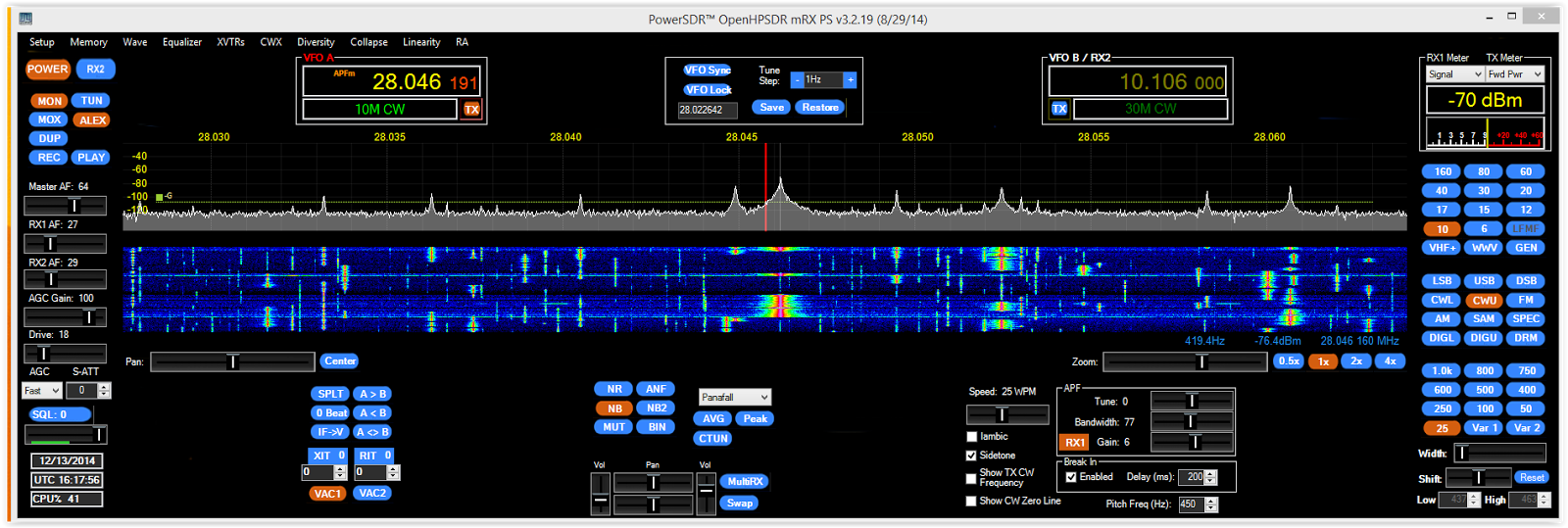
Here is a shot of the 10M pattern of my 80M vertical.  There is low medium and high angle radiation.  I decided to try a vertical dipole cut for 10M which looks like this


Imagine the dotted vertical line is a tree and the dotted horizontal is a branch.  Wire 3 angles back toward the tree and feed line 4 angles over to another tree to try and get as much seperation between the two as possible.  I was able to get the dipole up to about 50ft in the tree using my lead sinker pneumatic canon.  One shot was all it took.  I love this thing for hanging antennas.

The pattern for the dipole is like this


It still has some low medium and high radiation but the reduction in gain is reversed so the max is a low angle takeoff.  The 3D pattern looks like this


I did the analysis with and without the bent leg and feedline in the picture and the pattern skewing was minimal.  It was dark by the time I had things hooked up and the temp had dropped to the 40's and I was using a flashlight to see what I was doing... aka perfect antenna hanging weather.


I fired up the rig and the band was of course dead but I did manage to work FY5KE in French Guiana with a big signal the night before the contest 


I started working stations Sat and the band was pretty good but not outstanding.  A was 21 and K was 3, SFI around 150 


The station I'm listening to is Fred NP2X in the US VI.  The guy has a monster signal and is a monster of a contest operator.  I've known him since our college days at Univ of Ill.  

The band noise was quiet about -137 dBm.  I also set things up so I could A/B my 80M vert vs the 10M vert dipole at a button press.  What I found was pretty much what the patterns predicted.  On US stations the 80M antenna was a little louder.  On medium hall into EU or to KH6 the antennas were pretty much equal and on long haul deep into Asiatic Russia the dipole was a little better.

I could only operate a few of the best contest hours but managed to work 44 new 10 M countries all over the world.  I used every method I could think of to route out stations, spot collector which I set to spot only 10M spots


I used CW skimmer to skim sections of the band for new ones, and I also used the old tried and true method of starting at the bottom of the band and working to the top identifying every little blip on the panfall.  I used write log to do the dupe-ing


I did not setup the writelog band scope.  

As soon as the contest was over, I turned on all the bands in Spot Collector and saw S01WS in Western Sahara on 80M so I switched down there and worked him on the third call


To tell the truth I feel MUCH more at home digging the weak ones out of 80M static than up in nose bleed territory on 10M   Good times!

73  W9OY


Friday, December 5, 2014

So I'm driving to work this morning and glance off to my right and this is what I see:


This thing is a monster!  (I know there is a SDR in there somewhere so it counts :) )

73  W9OY