Clicking pics will provide more detail. For even greater detail right click pics and open in a new tab then use ctrl + mouse scroll to mag. These are often captured over 2 HD monitors and may need some magnification for full detail
Tonight while listening to 40M I decided to hook up skimmer to SpotCollector, the spot database client in DX Lab. The two can be connected via Telnet. Skimmer has a Telnet server built in.
To get there go view>settings>telnet. I have this server set up for SDR-Bridge so I didn't want to change anything because this server also populates my WriteLog Band map. I did add a password to get DX Lab to recognize the server. I used lowercase w9oy as my PW.
In DX Lab I opened SpotCollector config, and went to the spot sources tab
I filled in the boxes 127.0.0.1 under host address, skimmer for caption, W9OY for username, w9oy for password, and C under Cmd. I clicked on enable but left auto and hide unchecked and closed the screen. To add skimmer spots to spotcollector I click on the LED related to skimmer
and bring up the login dialogue box and hit connect
And skimmer connects to spotcollector and starts publishing spots.
Spotcollector's database tells me if I need a country or a bandfill and collects spots from my internet spot provider and skimmer. The reason I didn't autostart skimmer is it gives a lot of data and if a pileup is happening I want to be able to turn this feature on and off manually.
So that's it. I now get all the data automatically into spotcollector and that can be forwarded to DX Keeper (logbook) and Commander which is my interface to the radio, easy peasy.
This is the DXLab Link for directions but what I did is a modification of these directions. I checked the other programs which use skmmer server and nothing seems to have been jinxed
I believe I worked Jaun de Novo FT4JA tonight on 40M CW. I was stalking him on both 40 and 30 since my sundown @ 23:41Z. Very poor conditions. I never really heard him on 30M. On 40 I didn't hear him till close to his sunrise. As the terminator flew over his head, he came out of the noise and started to build, but never very much. I hung around waiting for my chance. You can never tell about propagation, and I figured as long as I could make anything out that was coherent I had a chance.
When I finally got him he was close to an hour into his daylight, and you can see
the pileup had nearly dried up, only 3-5 stations remained calling. Earlier in the evening the pileup was loaded across about 15hkz. They are sticking close to their band plan.
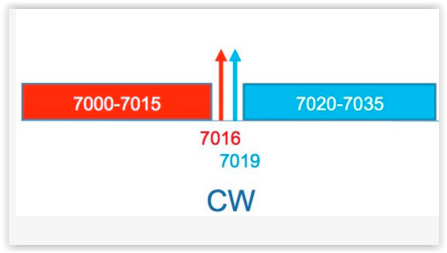
FT4JA has coordinated with VK0EK. On each band the 2 DX peditions have a similar format. VK0EK (in red) transmits on a lower freq in this case 7016 and listens down, while FT4JA transmits a couple KHZ higher 7019, and listens up. This consolidated the least amount of bandwidth and order giving the maximum throughput. Very smart IMHO. I had the radio set up on my half wave vertical end fed for 40M. It's a true 60ft custom vertical fed with a home brew parallel network and is over my 4000ft radial field. This antenna works very well as a DX antenna. My band noise was about -112 dBm
and FT4JA was just barely copy-able. He was undergoing deep fades but then would rebound. Every time he would fade I'd think to myself "well that's it" but I would listen a minute or two longer and there he would be calling ...up up NA. The band sounded very unsettled ike the propagation path was cracking up. If any one tells you the WBN noise blanker doesn't work in the Flex don't believe them. Here is my band noise with the blanker turned off
The difference between go and no go. I had the AGC turned off since he was so weak. I have found on 160 this often is the difference between a contact and no contact, so in extreme cases I'll try it anywhere. The danger is if someone fires up on the DX freq so I made a DDUTIL macro that will allow me to toggle between fast and off with one button click. It's pretty effective at saving the ears.
OFF allows for a fixed gain and the static/band crud does not trigger any AGC action, and when a station is 1-2 db out of the noise but the static is modulating at 2-3 dBm trough to peak no AGC can often make the difference. FT4JA was so weak there wasn't even any trail generated on the waterfall. I had him tuned in within 1 HZ and had the filter cranked to 50hz.
Here is a shot of how far into daylight he was before I lost him completely
The map was shot at 4:33Z and I logged him at 4:19, so not very much time to spare before the terminal fade.
I made a little Youtube vid
One is never sure you made it in the log when conditions are this poor, so I'm waiting on the greenie!
The DQRM and incivility has gotten out of control in the pileups these days. This DQRM on this pileup is the worst I've ever heard, and usually I'm pretty tolerant of DQRM. Maybe things will settle down. Maybe the DX needs to rock their frequency + - 200hz every once in a while. With 50hz filters if the DQRM is off by 35hz I'm not hearing them. Rocking the freq also makes people pay closer attention and not just keep mashing the transmit button. If you keep mashing the button but don't know where he is transmitting your chance of a QSO goes to zero.
73 W9OY
Took forever for them to upload the logs
My op was Christian EA3NT, outstanding CW talent and seasoned DX pedition pro
Tonight I was fooling around with DXLab SpotCollector's SQL tabs. SpotCollector has 32 buttons in 4 banks of 8 that can be programmed to filter the SpotCollector database on specific field criteria, like Band, Mode, etc. The filter can be quite complicated for example
only Spot Database Entries for SV2ASP/A
only Spot Database Entries for stations on 6m working CW
only Spot Database Entries for stations from Mongolia on 80m spotted from Europe
only Spot Database Entries for stations whose DXCC entities you haven't confirmed on CW
only Spot Database Entries for for African, European, or Asian stations on 160m that were spotted from the North American East coast.
I presently have only 8 Filters programmed. Above is a shot of un-programmed SQL buttons
To Program a button hover your mouse over a button and hit CTL before you click and the following panel will open up
(to get a clearer view of the pics click the pick and it will open a viewer)
My interest is primarily low band DXing 160M-30M CW. I have exactly 1 SSB DX QSO confirmed, but sometimes I want to see what is happening on other bands. The SQL language is not super intuitive so a couple examples
All Band in ('160m','80m','40m','30m','20m','17m','15m','12m','10m','6m')
This expression is contained in the field connected to the button called "All" This expression filters all modes and bands 160M-6M
160-30C Band in ('160m','80m','40m','30m') and (Mode= 'CW')
This button 160-30C turns on only 160 80 40 and 30 CW
160-10C Band in ('160m','80m','40m','30m','20m','17m','15m','12m','10m') and (Mode= 'CW')
This one 106-10C turns on 160-10 CW only
20-10C Band in ('20m','17m','15m','12m','10m') and (Mode= "CW") turns on 20M-10M CW
and I have a few single band choices as well
160 CW Band in ('160m') and (Mode= "CW") turns on 160M CW spots and I have one of thesae for 80, 40, and 30M as well.
That should be enough to get something going!
This is a shot of All note CW SSB RTTY JT65 are all listed from 160-6M
This is 40 CW only, though some SSB and Digital stuff sometime leaks through because it is mis-labeled in the database. NBD.
VK0EK is on the air. I tuned in on 30M and was amazed I could hear them as they are about 7 or more hours into their daylight as you can see on the map below, but they were very workable allowing for QSB
I studied the pileup and was able to determine where to call, in other words I made a lucky guess.
The pileup was down instead of up. VK0EK was on 10.116MHZ
I called him once and he came right back and we completed the QSO. VK0EK had specific instructions about how to work them on their web page and it always pays off to check the instructions. They wanted you to send your callsign and 5NN for the exchange, and so I didand was rewarded with a TU.
They have some kind of fancy realtime logging/propagation software
So I stopped by and popped in my callsign and this popped back!
All told maybe 10 seconds of transmit time. This Flex stuff is amazing as is their logging lash up! Great DX experience.
I watched the Falcon 9 launch this evening out of my window. an absolutely gorgeous launch. I was trying to get some election results on the TV and happened to glance out the windows of my sun room and caught the rocket just as it rose above the tree line. The time it takes between when the rocket lights up and when the sound reaches my porch is about 68 seconds.
I was headed off to bed and stopped by the shack to see what was on. Always a bad idea when I need some sleep. Tonight C5GCJ was pounding in on 40M. My noise on 40M tonight was about -112 dBm
But Zenon was peaking -86 dBm, a full 26 dBm out of the noise
The pileup wasn't huge but he was skipping around working stations in the pile making anticipation of where he was listening difficult.
I caught him near the top of the pileup and we were in each others logs
There are some Europeans and Ukrainians advertised in the cluster on 160M but I best toddle off to bed. Checking the bands while rewarding can be quite dangerous to sleep.
F2DX decided to stop off at Mayoette on his way to operate Jaun de Niva FT4JA at the end of the month. I caught him on 40M
And logged him thus
He had a good signal but variable. I caugth him close to his morning terminator as the grayline was passing Madagascar. Should give a good clue to Jaun de Nova propagation
Pat is an excellent op and had the pileup stand by to pull me out of the mud for which I am very grateful. His comment was QRN.
So I was fooling around and noticed there is a contest for every band tonight. 160M has the Stew Perry, 80M has the Tesla Memorial, and 80-10 has the RSGB Commonwealth commonly called the BERU.
The exchange for the SP is 4 character grid square, for the TM its RST serial # and grid square. and for the BERU RST + serial# I loaded the BERU log up in Write log and found I could enter all of this in a way that would allow me to differentiate contests. I set up the 6500 for SO2R/V
The skimmer/bandmap on the left is 80M/Tesla-BERU contest. The skimmer/bandmap on the right is 160M/Stew Perry. I have the audio pan set for 20 toward the left, and 80 toward the right. I have 2 knobs attached. The latest version of SDR-Bridge by W2RF allows for Flex controls to act as SO2R/SO2V knobs. One knob tunes the 80M pan, and the other the 160M pan. The buttons on the knob allow for each knob to control RIT, XIT, AGC-T and Vol as well as freq for each connected slice. It's my poor man's Maestro. Here is a shot of the knob setup screen in Bridge.
Other configs can be set up for a single knob which can be used across more than one slice. As many as 4 knobs can be accommodated for those with ADD more severe than mine.
Here is the left radio for 80M/Tesla-BERU contest
And here the right for 160M/SP
My amp and antenna switch are set up such that a band change in the radio forces a corresponding band change on the amp and switches antennas to a resonant vertical on each band. There is enough signal on each antenna that the alternative antenna has plenty of signal for SO2R/V. The 80M is a full size vertical and the 160 is a high inv-L both resonant to 1.2:1 or less on their respective bands, so no tuner involved.
Write log uses the up down buttons to switch bands. I can also switch bands by clicking on either pan. In addition the skimmers populate the writelog Band maps with stations. By clicking a station on a band map the callsign is entered into the correct field in writelog. Or I can click a station in skimmer and that is entered into writelog ready to complete the contact. I tend to run narrow filters (100hz) so the knbs are handy for fine tuning. If I was truly contesting I would use wider filters, but I'm just goofing around.
So there you have it a 6500 running SO2R/V running 3 independent contests on 2 different bands all at once. Maximum efficiency!! I programmed the correct memory exchanges into my keyer so now all I have to do is keep the damn buttons strait!
I actually didn't make any contacts in the SP because the rules recommend no assist and skimmers etc constitute an assist but I did want to set this up and see how she flew. I also have a wellbrook active loop antenna in RX-1 which would allow me to add more slices and switch between more bands, like 40M to run the BERU, but that's getting to be too confusing. That ant gives good output on all bands to 20M (actually higher). With the FullDuplex active this thing rocks!