Friday, February 10, 2017

Power Genius at Orlando


I went to Orlando Hamcation today to see my Flex Radio buds, especially hoping to get a preview of the new Power Genius XL amp.  It was there, connected to a 6700 in all of its glory heating up a huge bird dummy load.  The price will be essentially $7K.  It is a fully functional, full 1500W QSK SO2R powerhouse.  

The amp has 2 1.5 KW LDMOS power transistors and is easily capable of 1500W 100% duty cycle operation in ICAS service.  What that means is you can run the amp at full output.  If any parameter faults (like temp) the amp will shut itself down until the parameters come back in line.  So you can use the amp to run a RTTY contest and as long as you come up for air once in a while no problemo.  The amp has an excellent cooling system which is very quiet and advances its aggression as the transistors require.  The fan advances in a relatively linear step-wise fashion, in other words it isn't quiet and full blast but gently advances and recedes as junction temp dictates.  I made a quick cell video at the bottom to demonstrate.  The amp has a very cool feature (pun intended) in that it automatically adjusts its class according to mode, so CW is running in class C and SSB is class AB.  I totally love this idea.


This is a shot of the 6700 and the amp.  Note width and length the amp and the radio are virtually identical but the amp is about twice as tall as the radio
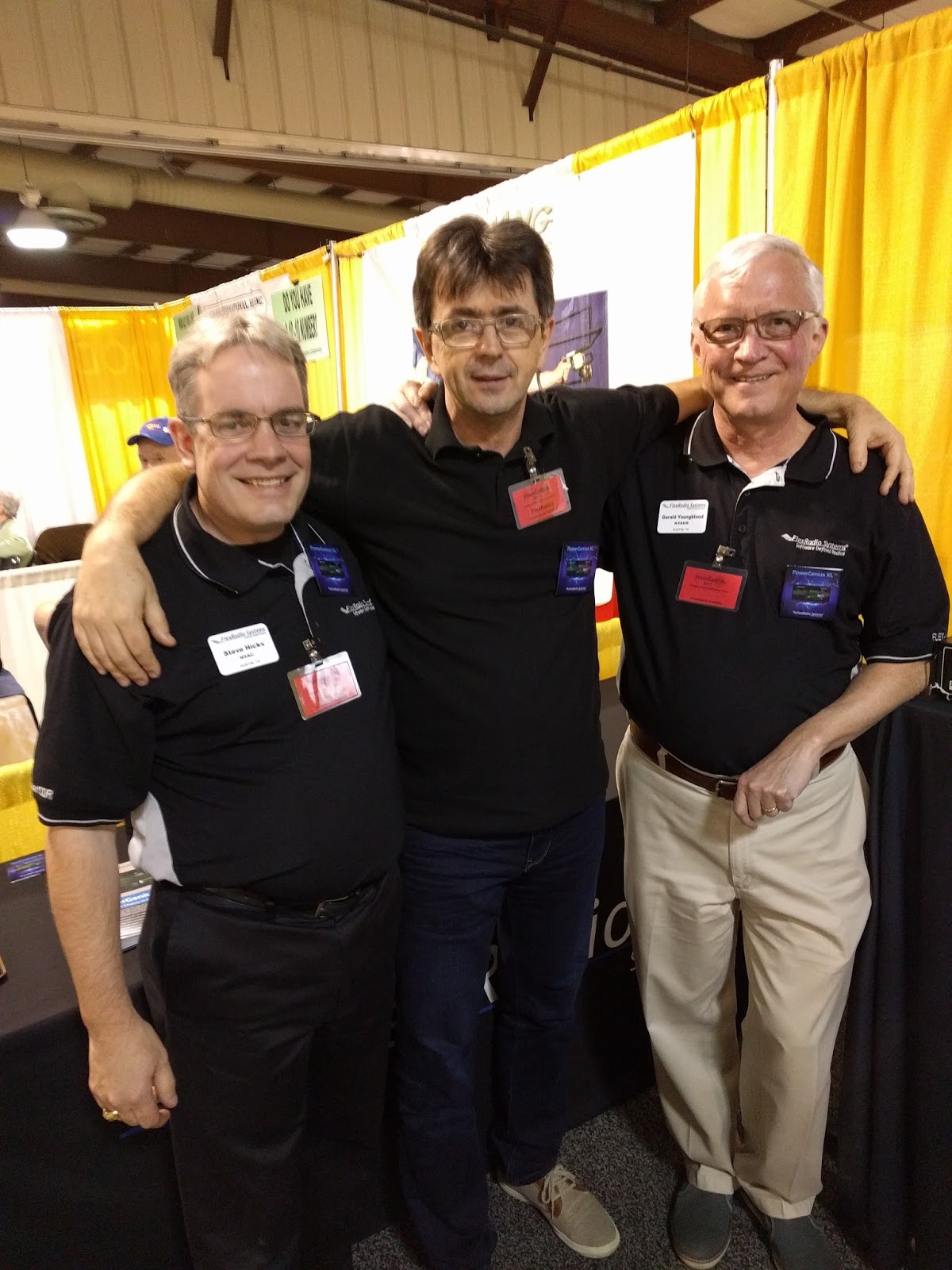

Here is a shot of the three brainiacs involved and friends of mine.   L to R Steve Hicks N5AC VP of engineering at Flex, Renko Boca 4O3A Power Genius designer and proprietor of 4O3A.com,   and Gerald Youngblood K5SDR who cooked up the Flex SDR revolution.  I started with Flex in the early 3 board stack days and never looked back.  As the Grateful Dead say what a long strange trip its been.  The amp is fully integrated with the Flex line of radios using Ethernet server client connectivity, but also provides access for other brands of radio transceivers allowing for automatic functionality.

The Power Genius brings full SO2R functionality to a single amp, and with a 6700 only 2 components namely the 6700 and the Genius, a computer and contest software like N1MM+ or WriteLog and incidentals like a Mic, paddle or digi software and maybe a Flex Control you are SO2R on the air

Here are the guys and the equipment mugging for my blog shots


The amp is self contained with a big honkin server power supply yet weighs in at only 33lbs.  The power supply has a wide ranging input voltage capability  so this might be an ideal amp to lug on down to the Islands for things like CQWW or various DXpeditions.  More can be learned at the Flex site   The QSK is butter smooth.  Color me impressed.  Impressed enough to become $7K poorer.  


Notice how the green light turns red when transmiting.  It turns purple when doing an update like the 6700.  It is now FCC type accepted


73  W9OY


Thursday, February 9, 2017

TL8TT Central African Republic


Finally got them tonight on 40M.  They are about 3 dB out of the noise but perfectly copy-able when the tuners and callers are not on he DX freq  

They are running a near instant logbook and using it as a means to finance the DX-pedition


Amazing technology  Tomorrow ORLANDO


73  W9OY


Saturday, January 28, 2017

CQ 160M CW


I've been running the 160M test this weekend, and it's been a blast.  The bands aren't super good, and I have a fair amount of noise @ -103 dBm.  Flex has done a LOT of work streamlining the contest aspect of the software, and it is really paying off.  I'm running the latest alpha code.  Flex sent out an update to test in the middle of the contest and I decided what the heck and updated in the middle of the test.  It was flawless.  I'm running N1MM+ and I'm using CW skimmer to populate my N1MM+ bandmap 


Skimmer copies only what I can hear with the radio, the internet is shut off at this time.  As you can see there are plenty of activity.  This is 160M at 17:00 Eastern.  Skimmer telnets the data into N1MM+

The band map sorts what skimmer hears v what I have worked and it lists new stations and DX so I just click down the list picking up countries and mults.  The 6700 does a REALLY good job of hearing things.  I'm running with the filters set at 50hz and its very easy to click a station and work it.  If it's off a little I have a Flex Control (aka a knob) to fine tune.

Here is a shot of my desktop


Included in the mix is DXLAB.  Skimmer is also acting as a server to DXLabs spot client "Spot Collector"  Data is sent to SC and if I work some new DX I can import that data immediately into my DX log from SC without missing a beat.  SC compares spots as they roll by with stations in my DX logbook so I can immediately bre alerted to something I need.  This contest is mostly domestic but I'm seeing more DX than I anticipated. 


Another advantage of DXLab is the world map.  Since the only stations I am spotting are stations I can actually "hear" on the local antenna it's worth while to cruise these red dots.  Very often it yields a new country.  In fact I worked 25 countries in about 6 hours of contesting. 


Flex has been working on a Winkey emulator.  The emulator is a software version of Winkey.  It doesn't completely emulate Winkey but for the objects emulated such as the keyer and memories and keyboard keyer it is excellent and it integrates tightly with N1MM+.  Very nice.  I could set up a version of SO2R but I'm rather enjoying a very laid back contest experience.  Other programs include SDR-Bridge which I use to interface my Flex Controls. and DDUTIL.  In DDUTIL I have  sevral custom macros programmed which allows me to change things like screen resolution AGC-T, filters (I have created several custom defined filters)  and others that tailors the entire experience to my liking.

73  W9OY 

Redux:  I worked 159 stations in 12 hours of S&P, 43 sections and 25 countries.  I found new ways to utilize the information my station gathers as the contest progressed.  I was disconnected from the internet, so the information I gathered was strictly in my own universe.  I was able to hear more than I could be heard and left between 5 and 10 countries on the table.  It was interesting to hear EU  Russian and Middle East countries working each other in the contest.  QSB played a role which is common on 160M and I had to keep rolling by trying to work stations as conditions changed, but I could immediately and randomly survey the band and persistent checking and then calling generally paid off.  I heard nothing out of Asia or the Pacific.  I left the robot running while I slept and then reviewed my accumulated  data and no contacts to the west beyond CA were noted in the data.  

Thursday, January 12, 2017

JT-65 and the Flex

I decided to give JT-65 a whirl a couple days ago.  JT-65 is a weak signal protocol developed by Princeton physicist and Nobel Laureate Joe Taylor K1JT, and is designed to  augment contacts using meteor scatter and EME.  The protocol uses FEC and can literally hear signals under the noise.  There is a HF variant called JT-65 HF so I decided to start there.  I downloaded JT-65 HF client


and it worked but on reading more I found WSJT-X is the one being upgraded and maintained so I switched to that client


Setup with the Flex 6xxx radios is trivial.  Under file open settings, and append as needed. 


Turn on RX stream 1 and TX stream in DAX


And set the audio input to PC and turn on DAX


Set the audio level in DAX TX stream to make sure the ALC mark on the level meter is not reached 


I run about 20W.   (Note I made this shot before I had the ALC set correctly the bar should be either green or just yellow NO RED)

JT-65 is an alternating mode.  One station transmits for 48 sec and then stops.  The data sent in that 48 sec is decoded and displayed in the left window.


During the 12 second window you decide what you want to do.  In the above I note K4CMS is calling CQ so I double click his call in the left window and his call is transferred to the right.  Enable TX is also enabled.  At the completion of the 12 sec my transmitter turns on for 48 sec and calls K4CMS.  He hears me and replies with a report, I ack and send him a report, we exchange 73's and I log the QSO.  It is necessary to have very close temporal coordination (meaning your clock and the other stations clock must match very precisely.  For that I use a client called Dimensions 4.  


This software automatically links to time servers and keeps my puter clock very close to
 0.0 seconds error.

The interesting thing about JT-65 is how well DX can hear you.  The  WSJT client automatically reports out to PSKreporter


All the little ovals are stations that report hearing me including VE9CD up in Canada.  As the night progresses my 20W is easily copied by stations in the Middle East Africa Russia and all over Europe

There is a lot more to read and know, in fact it's addicting and a lot of fun.  Give it your own whirl if you have a Flex 6xxx radio

73  W9OY


Saturday, January 7, 2017

USB cable


FTDI C232HM-EDHSL-0

I've been running some version of BCD breakout combined with my Flex radios for a decade.  I used parallel ports, and a USB to parallel converter with DDUTIL, and recently I used a USB-8 relay device to switch +5v onto the 4 lines needed to communicate with my amp and antenna switch.   Flex has added a dedicated means to get band data out of the radio to control external devices.  The cable is made by FTDI and is $26 from Mouser   The cable plugs into the USB port on the back of a 6XXX radio.  Added to the software is a new "USB cables" field under settings.  


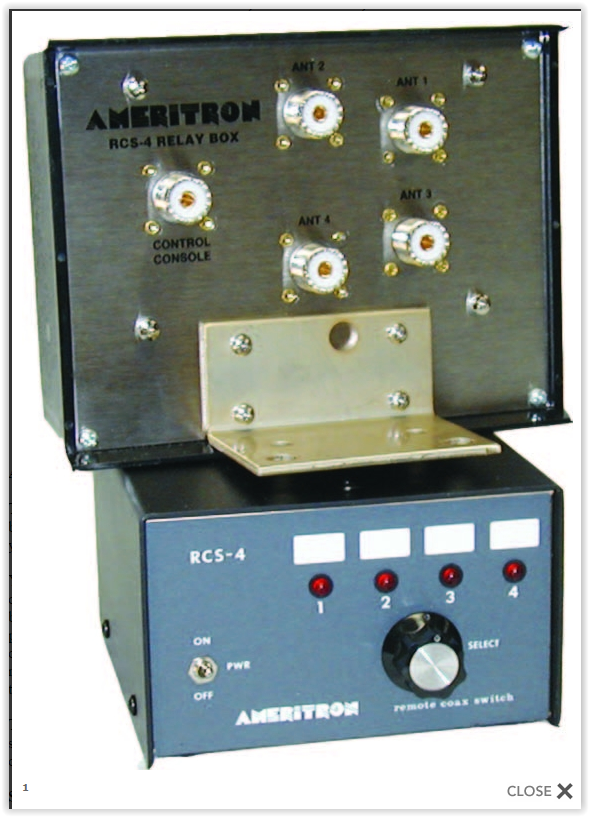
More than one cable can be added and they give CAT, BIT, BCD, LPDA and DSTAR hardware data choices to allow control by the radio to peripheral hardware devices.  My amp is a ALS-1300 and it allows remote band-switching using Yaesu BCD code.  Years ago I modified a MFJ RCS-4 antenna switch to automatically bandswitch to Yaesu BCD as well, using a Unified Microsystems BCD-10 (now replaced with a BCD-14.  The BCD-14 can control up to 13 bands of antenna from 160M-70cm, using Yaesu BCD.  So my choice of cable is the above C232HM cable, but other choices exist depending on need.  


As is shown there are 5 bits to the BCD code.  Normally there re 4 bits but the field has been expanded to allow for VHF/UHF/SHF transverter choices to be accommodated, so you can control virtually any device probably up through light by judicious programming of the cable.  I'm only interest in HF programming so I set things up for that.  The reason I include the expanded coverage is to point out how powerful this device is.  Note also 60M is represented as 00000 for a band choice.  I use this in my scheme to automatically switch in the antenna in my stable of antennas that loads best on 60M.  It turns out my amp does not recognize 00000 so the amp does not transmit when 60M is chosen.  How convenient is that?


Included here is a breakout board I built including parts listed.  The board is wired such that a standard  CAT5 cable can be inserted between the RJ-45 and the ARI-500/ALS-1300.  LED's were included to easily troubleshoot any issues.  I later added a Unified Microsystems BCD-14 to run my antenna switch  


My latest antenna system uses a inv-L for 160, a vertical wire for 80, a 1/4 wave vert for 40 and a 18 foot wire parallel with the 40M.  The 160M antenna also tunes 60M with SWR less than 1.6:1, and the 80M also tunes 30M with a SWR of 2.5:1, and the 40/20 combo tunes 40M with 1.2:1, 20M with SWR 1.8:1, 17M with SWR 2.1:1, 15M with SWR1.25:1, 12M with SWR 1.9:1 and 10M with SWR 1:9:1.  10 bands auto-switched!   I have a MFJ 998 auto tuner for touch-up tuning. 


 Here is a pic of the finished breakout box with breakout for both amp and antenna switch.  The switching is very fast, easily fast enough for SO2R

This new cable from Flex is highly recommended if you're interested in automating your station.

73  W9OY


Thursday, December 1, 2016

YO3APJ Romania


I have my radio setup for auto band switching.  After Hurricane Matthew tore down my antennas last month I've been in a rebuilding mode.  Auto band switching means my amp and antennas band follow my transmitter which is a Flex 6700


All of the antenna cables from the 6700 are represented on a patch panel which resides next to my left leg, screwed to the table underneath the table top.  My amps, tuners, power meters, and antenna switch controller all present jacks on my patch panel in a 4 x 8 matrix.  My 6300 and 6500 Flex are also represented on the panel.  I have a separate panel for switching radio amp signals to my various amps, so its quick work to join   The 6700 sends its RF to join a transceiver to a amp to a antenna.  My 6700 generally feeds my ALS 1300 


That amp generally feeds my MFJ-998 


And that feeds either my RCS-4 antenna switch or my G5RV.  


It allows me through software and to choose my antenna.  I modified the RCS-4 to automatically band follow my radio and the 4 positions allow me to cover 160M, 80M, 40M, and 20M with resonant verticals and I can tune 80M to cover 30M with little loss, and 40M to cover 15M.  80M will also load on 60M efficiently and 12M and 10M will load.  17M is a little flakey.  My antenna previous to Matthew was a 65ft vertical, a 130ft inv-L, a half wave 40M end fed vertical and a 5/8 wave on 20M all over 4K feet of ground plane.  It was a flame thrower.  Today I've rebuilt with a 33 ft vertical using fiberglass telescoping pole.  My pole is made from some parts that are very light but strong.  I don't use those joiner things just a couple hose clamps, one on the bigger pole to help keep the end from splitting and then some tape on the telescoping piece and another hose clamp compressing the tape.  Makes a perfect reliable joint.  2 wires go up the pole, one for 40 and another for 20.  To support the pole I pounded in a steel mast like the kind used to telescope for a TV antenna.  The vertical slips over the mast and it is both vertical and strong.   I have a second shorter pole which starts my 80 and 160 antennas to about 16 feet and then those wires continue up to a branch on a tree where the L goes out to a second tree.  These antennas can be lowered in 1 minute.


DXlab is set up so if I click a spot like YO3APJ on 3505, every goes to 3505 and I have a couple tuning macros which allow the tuner to touch up the tuning, and I'm ready to call.  I have a macro which puts my transmitter via XIT UP THE BAND by 2 khz to keep from tuning on the DX!  I hate that.  Not only is it inconsiderate, it shows the tuner upper is a moron since it would be better to tune where you are going to transmit as in the case of a pileup.  My setup can tune at about 8 watts of power since the amp is no tune all I have to do is match the antenna.  For receive I can move the G5RV feedline from the tuner to the RX2 input on the 6700 and I also have a ALA-100 Welbrook active loop on rxB and I can choose any pair of the receive antennas with my diversity choice on the 6700.  I loved the beam forming feature in the 5K and Anan, but I find the diversity setup in the 6700 to be very versatile when it comes to weak signal work.  It's easy to write macros in DDUTIL to
 click between antenna pairs and compare which pair has the best advantage.  I still have a couple more antenna slots to add to the mix

I heard Adrian YO3APJ on calling CQ and working simplex and I'm still trying to see how the new verticals perform, so I gave him a call.  Adrian gives honest reports so I knew it would be a good test.  Came back as 599 "booming signal" (yep Adrian gives honest reports :) ).  The antenna system seems to be shaping up pretty well.  The bands have been hot but I seem able to couple adequately into the aether.

73  W9OY


J3/VE7ACN Carriacou Island Grenada


Off the North coast of Venezuela is a place called Carriacou Island and Ve7ACN has placed it on the air.


Easy shot from the US, big S9 signal and good op


73  W9OY