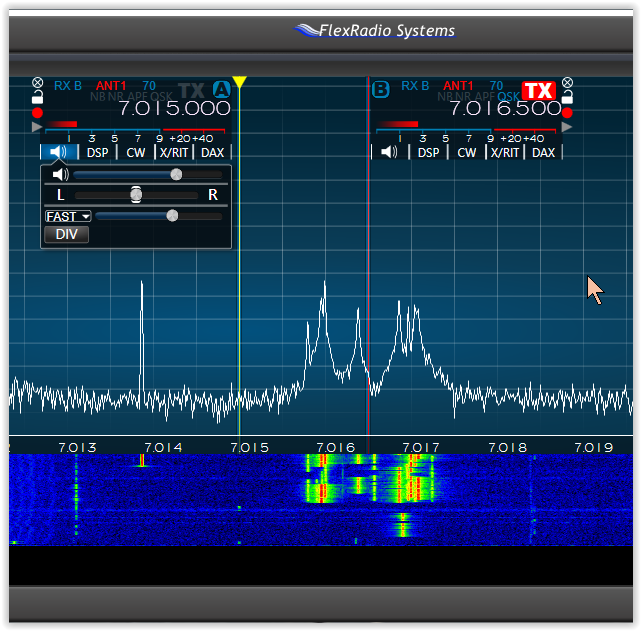
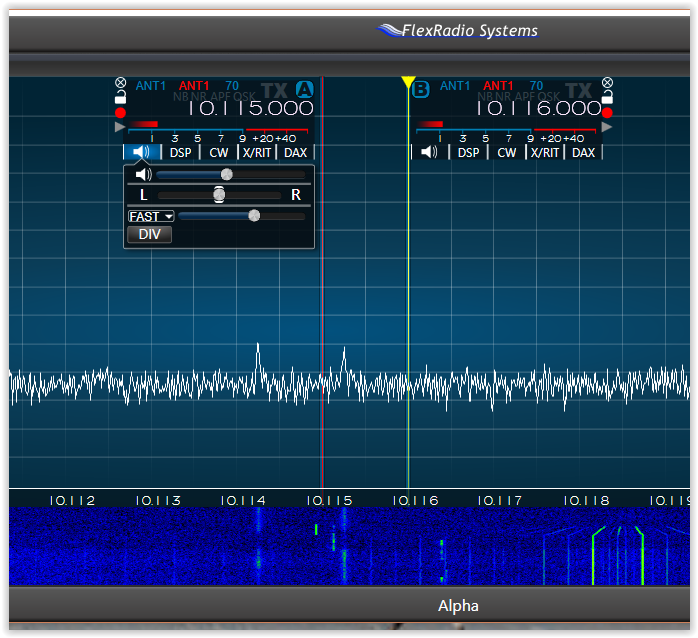
I ran the ARRL DX CW contest for a few hours this weekend and had a great time. I recently installed a W6LVP RX loop antenna and wanted to see how it would work for the low bands., 160, 80, 40. My set up is as above. I feed the signals copied by the radio into CW skimmer via DAX where they are decoded.
Then via telnet to N1MM+ and DXLab Spot Collector. I turn off all internet spotting, so what I see on the N1MM+ band map and in Spot Collector are strictly signals received on MY antennas.


The countries/multipliers I need are listed in RED and I can click the station and the radio moves there, loads the callsign in a staging area (note the YR8D above the entry window) If the station is present and workable, I click the staged call and it is loaded into the entry window and I proceed to make the contact. I then move on to the next RED station in the list. I can also use skimmer as a VFO of sorts. Since Skimmer generates the raw callsign data I can use the skimmer VFO controls to quickly click up and down the band 10 khz at a time, and work any RED in a given 10 khz segment. Once all the RED is turned light BLUE it means there are no more new ones to work and I move up or down another 10 khz. This allows me to work virtually all the hear-able DX in a 60 khz band segment really quickly. It's kind of like combing your hair. With each stroke more and more DX is accumulated. I keep an eye on the DXLab Spot collector as well. This database is screened by my wants/need list from my logbook. If a ATNO comes up it blazes in RED as well. If a band fill comes up it is in MAROON. This allows me to increase my DXCC score as well. I simply click on the needed station in Spot Collector and N1MM+, Skimmer, SSDR and the radio all head to the right freq. I tune in the station precisely and make the contact. The data from Spot collector is automatically entered into my logbook.
Once I finish off all the new DX on one band I start in on another band. Soon enough that band has been combed out and all the RED has been worked and logged, and on to another band. I have found this to be a VERY fun and useful way to run a contest and it puts the Flex system to full advantage. The wide band DAX feed analyzes in my case sends 48 khz of I/Q data into skimmer so my skimmer feed is always updating and as I move up and down that 48 khz window moves up and down with me refreshing skimmer.
Another way to "tune the system is by the DXView map
As the radio hears signals the DX stations are populated on a grayline map. Each dot provides tooltip data to the underlying stations callsign, freq and time heard, so I can click particular stations of interest. For example the Island stations out in the Pacific. As the grayline progresses these stations often build until they become workable. It's a VERY valuable way to fill out what otherwise might be fringe contacts and not miss anything. Last night I got Asiatic Russia using the map technique. I hit him just as they grayline flew over his head but before the pileup ensued.

I added this W6LVP loop to my station last weekend, and decided to wring it out in this contest. It made a HUGE difference in what I could hear on 160 and 80 and to a lessor extent on 40. I ran the antenna exclusively on RX. The DX contest is a good test of any system and there was no overload or distortion products. My system is set up with a Flex control (aka a knob) which allows fine tuning of the radio and I run generally 70hz bandwidth on my RX so fine tuning is often necessary. There is virtually no interference. If you look at the above SSDR picture closely, even though I'm surrounded by many STRONG stations if I'm not on their freq I don't hear them. My noise level is the same as the band noise in a quiet part of the band, and that is very quiet on the loop. My band noise was running typically -113 dBm (S2 range) on 160M and -118 dBm (S1 range) on 80M. Without the loop band noise was up around -95 dBm or S5.
My results? I ran for a total of 412 minutes (6:52) over the 48 hour 2 day contest.
In that time I managed to work 141 countries and a total of 162 contacts. I was not trying to amass the biggest score, but I wanted to see how well the antenna worked. It was fabulous! I could hear everything! I worked out EU until I was so far into their daylight (like at noon in DL on 40M I could still copy stations and at 2PM EST I was already able to work EU this afternoon. As EU faded JA and UA0 came into focus along with VK ZL KH2 Guam and half a dozen others on both 80 and 40, so condtions here were good. I have an inv-L on 160M, a vertical wire hanging out of a pine on 80M as well as a 40M 1/4 wave al over the same ground screen, about 4k feet of #14. My amp is automatically band switched by the 6700 and I have a antenna switch which switches in each bands vertical automatically so it makes contesting very easy.

I managed to increase my DXCC total by 5 countries and several band fills on each band. Operating the station was so addictive I was up till 4:30 am and eventually had to force myself to put it down. so mu butt is dragging right now. Without the loop I'm sure the noise would have worn me down hours earlier. Total score was 67,257 and I worked 24 zones not bad for 412 minutes of operating time and a couple wires hanging out from a tree!
73 W9OY